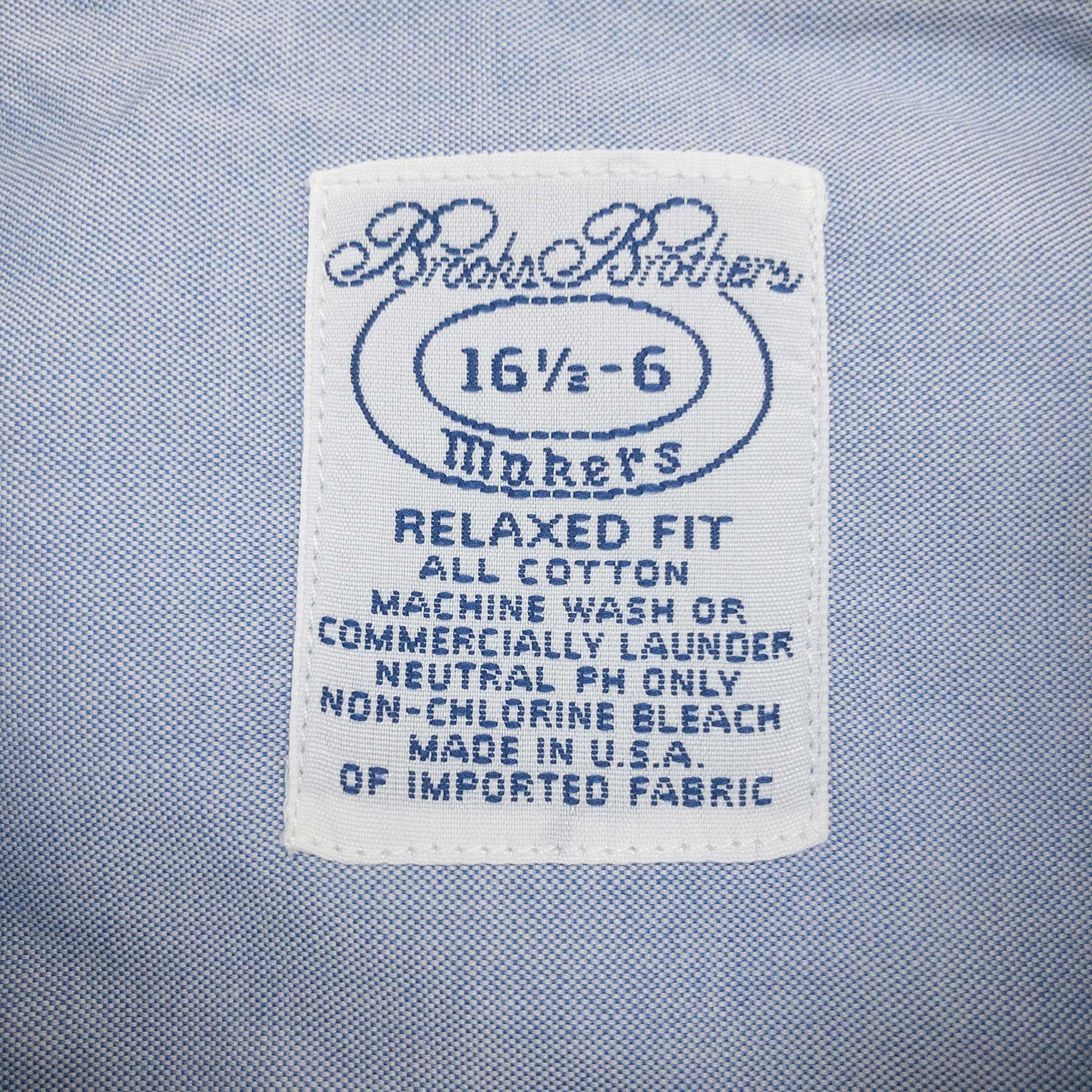
When researching older Brooks Brothers clothing, you may encounter the words “Makers” or “Makers & Merchants.” Makers is commonly associated with Brooks Brothers’ own-factory production, or “own make.” That interpretation, however, cannot be applied to every period and product. Understanding both the background of the words and their exceptions allows us to read labels more carefully.
Makers and the idea of own-factory production
In vintage clothing descriptions, Makers is sometimes explained as indicating a garment made in a Brooks Brothers factory. For example, vintage retailer JAM connects Makers with sewing in the company’s own U.S. factories. Source: JAM’s guide to Brooks Brothers
Here, “own make” means production by the company itself. This interpretation finds in the word Makers the history of Brooks Brothers as a maker as well as a merchant. It should still be treated as a common understanding in the vintage market, separate from an official identification rule that applies to every product.
Making and delivering
Makers means those who make, while Merchants means traders or sellers. In its entry for the company’s founding in 1818, the official European timeline describes an approach that brought manufacturing and selling together. The phrase conveys the brand’s commitment from making a product through delivering it to the customer. Source: official European timeline
A useful exception: a Japanese reproduction shirt
A Japanese reproduction shirt is one example showing why the Makers wording alone cannot prove own-factory production.
On an official Brooks Brothers product page, the company explains that a six-button indigo dress shirt, style 100204474, was based on a 1980s polo-collar shirt and that its shape, details, and Makers woven label were reproduced by a long-established Japanese factory. The country of origin is also listed as Japan. Source: Brooks Brothers Japan, six-button dress shirt
In this case, Makers also functions as a reproduced period design element. Judging that the shirt was made in a Brooks Brothers-owned U.S. factory, or that it is an original garment from the 1980s, simply because the word appears on the label would confuse a reproduction with an original. The product description does not establish who owns the Japanese factory. What this example does establish is that Makers does not universally guarantee U.S. own-factory production or an original period garment.
Founding language and a label’s date are separate matters
Even if the phrase is used to describe the company’s founding principles, a label bearing it is not therefore from the founding era. Establishing when a label was used requires comparison with period documentation or garments whose dates are known.
Likewise, the word Makers alone cannot determine a particular factory or country of production. The origin of the phrase and when and where a particular garment was made are separate questions that require separate evidence.
Keep the surrounding information when reading a label
When you find an interesting garment, it helps to photograph not only the neck label but also care and content labels attached at the side or elsewhere. This preserves the arrangement of the text, size, country of origin, material, and style number for comparison.
The lettering and atmosphere of a label are part of the pleasure of vintage clothing. Let that impression prompt further research, while supporting any conclusion about date with evidence. Read in this way, the short phrase Makers & Merchants can reveal both the brand’s outlook and the information carried by an individual garment.