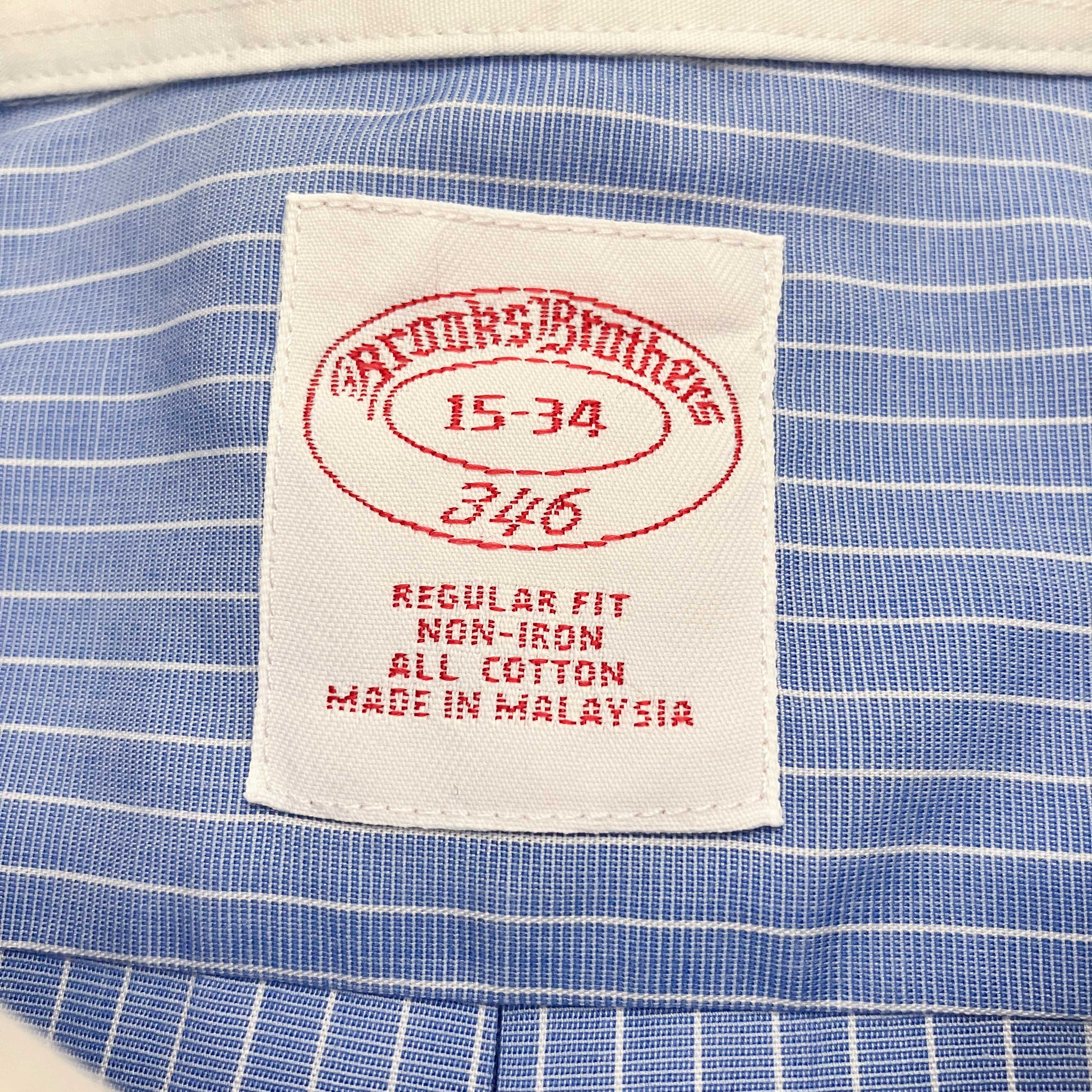
15 1/2 is the number used to choose the neck size
When looking for a pre-owned Brooks Brothers shirt, you may find a label marked “15 1/2-34.” If you usually buy shirts in S, M or L, the notation can feel unfamiliar.
The first number is the neck size and the second is the sleeve-length size, both in inches. Here, 15 1/2 is the neck size and 34 is the number used to choose sleeve length. Reading the two separately gives you a useful starting point.
That does not mean the label alone proves that a pre-owned shirt will fit. This article explains the notation and the measurements to check next.
15 1/2 means fifteen and a half inches. A label written 15½ means the same thing. Brooks Brothers’ U.S. product pages also let customers select Neck Size and Sleeve Length separately. Brooks Brothers U.S.: dress shirt example
At 2.54 cm per inch, 15 1/2 converts to about 39.4 cm. For reference, 14 1/2 is about 36.8 cm, 15 is 38.1 cm, 16 is about 40.6 cm, 16 1/2 is about 41.9 cm and 17 is about 43.2 cm.
This conversion does not guarantee the measured length of the collar on the actual garment. A shirt labelled 15 1/2 will not necessarily measure exactly 39.4 cm around the collar.
For example, the Japanese product page for broadcloth dress shirt style 330000373 lists a 41.0 cm collar measurement for size 15 1/2. The labelled size and the garment measurement need to be read as separate pieces of information. Brooks Brothers Japan: product measurements
Allow room at the neck for the way you wear the shirt
When I worked part-time at Brooks Brothers, our fitting guideline was to measure the neck with two fingers between the neck and the tape. We considered the ease needed when the shirt was worn rather than choosing only from a skin-tight measurement.
Two fingers was a practical guideline used in customer service at the time. Finger thickness varies, so it cannot be converted into one fixed number of centimetres. Preference matters too. Someone who closes the top button and wears a tie has different requirements from someone who always wears the first button open.
If you close the top button, check how restrictive it feels in that position. Even when you plan to leave it open, do not size down from the neck alone; consider the balance with the shoulders and body. Keep the body measurement, label size and actual collar measurement distinct when choosing a shirt for the way you dress.
34 is not simply the length from the shoulder seam
The second number, 34, is the sleeve-length size. The corresponding measurement runs from the centre back of the neck, across the shoulder and down to the cuff. It begins at a different point from a flat “sleeve length” measured from the shoulder seam.
Even though the English term is Sleeve Length, it may not be directly comparable with a pre-owned listing that measures from the shoulder seam. Converting 34 to about 86.4 cm and assuming the sleeve itself is 86.4 cm long will lead to the wrong comparison.
The same Japanese product page lists garment measurements for sizes 31, 32, 33 and 34 under the Japanese term for centre-back-to-cuff length. Check whether the label and the seller’s measurement refer to the same points. Brooks Brothers Japan: sleeve measurement table
How much difference is there between 32, 33 and 34?
By simple inch conversion, 32 is about 81.3 cm, 33 about 83.8 cm and 34 about 86.4 cm. An increase of one number equals 2.54 cm in the nominal conversion.
Again, these figures are not guaranteed garment measurements. For style 330000373, the Japanese size table lists 82.6 cm for 32, 85.3 cm for 33 and 87.9 cm for 34. Those figures apply to that particular product, not every model or period. Brooks Brothers Japan: style 330000373
Two shirts can share the same neck size but differ in the second number. Do not stop at “15 1/2 fits me”; read the sleeve number as well.
On older labels, “2” can be an abbreviation for 32
Some older Brooks Brothers shirts abbreviate the sleeve size 32 as “2,” omitting the 30. A label such as “17-2” therefore means a 17-inch neck and a 32-inch sleeve size. The final 2 is not an independent size code or a two-inch sleeve.
This is a reading I have also seen on older shirts handled by the store. We have shown examples on Instagram. Simple Design Store: shirt-size label post
The abbreviation alone cannot establish a production year. Use it to understand the label, then confirm the measurements of the individual shirt.
You may also find two numbers, such as 32/33
Our Instagram post uses labels such as “17-34,” “16-32/33” and “15½-32” to explain neck and sleeve sizes. Some labels show two sleeve numbers, such as 32/33. Simple Design Store: shirt-size label post
The first number still indicates the neck and the figures after it relate to sleeve length. The precise meaning and any adjustment method should, however, be checked against the construction of that product.
When a cuff has more than one button position, moving the button changes the cuff circumference and can alter how the sleeve settles at the wrist. It does not lengthen or shorten the sleeve fabric by an inch. Do not assume that two printed numbers mean the sleeve length is freely adjustable; inspect the cuff and the measured dimensions too.
Can it simply be converted to Japanese S, M or L?
It is best not to convert 15 1/2 to a Japanese M, or 16 to an L, as a universal rule. The neck number alone tells you nothing about shoulder width, chest width or room at the waist.
Shirts with the same neck size can fit differently when the fit changes. The Japanese product page above also notes that the dimensions differ from the former Regent Fit. Even an identical fit name does not guarantee identical measurements. Brooks Brothers Japan: fit note
Use the neck and sleeve notation to narrow the options, then compare shoulder, chest and length measurements. This order makes the label useful without ignoring differences in actual fit.
For pre-owned shirts, move from the label to actual measurements
With a pre-owned shirt, the important question is what the garment measures now. Washing, drying or sleeve alterations may have affected it. A difference from the label does not by itself prove shrinkage or alteration, because labelled and product measurements can differ from the start.
A comfortable shirt you already own is a useful reference. Compare shoulder width, chest width, sleeve length and body length using the same measuring method. If a centre-back-to-cuff measurement is provided, compare it with the same measurement on your own shirt.
For a closed collar, check the neck. For movement, consider the shoulders and body. For where the cuff sits, check sleeve length. The two numbers on the label are an important entrance; actual measurements make the buying decision concrete.
On our Shop by size section, you can browse current stock by neck size. When you find a shirt, check its sleeve size and measurements in the Mercari Shops description.