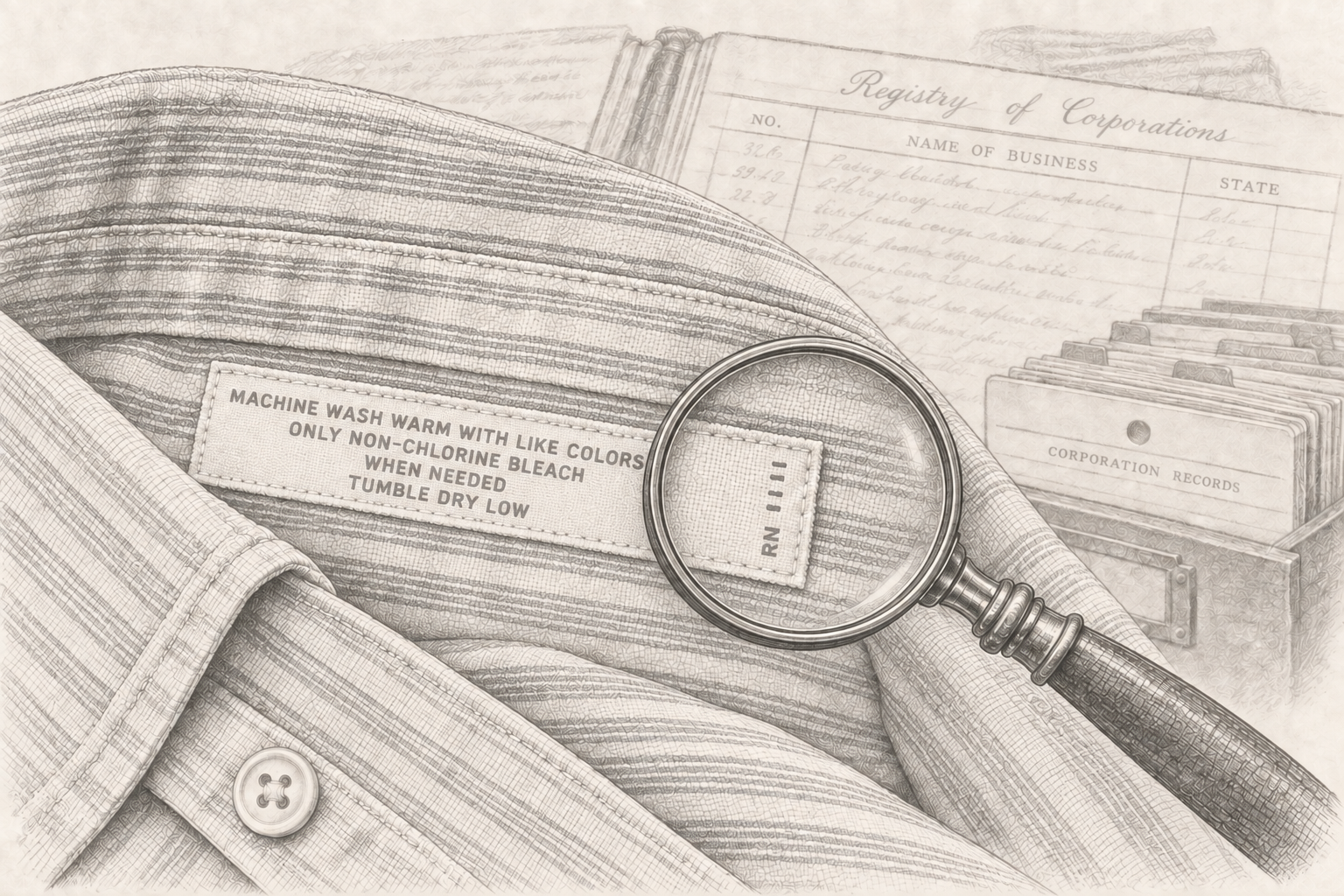
On vintage clothing care labels, you may see “RN” followed by a number. It can look like a model number, but it identifies a business. Looking up the registrant can provide a clue to a company involved in manufacturing or distribution that is not evident from the brand name alone. It is also a useful detail when researching the makers behind Brooks Brothers clothing.
An RN identifies a business
According to the U.S. Federal Trade Commission (FTC), an RN is issued to a U.S. business that manufactures, imports, distributes or sells products covered by the textile, wool and fur laws. It is not a number assigned only to sewing factories. Source: FTC, “Registered Identification Number FAQ”
Because of this system, identifying the registered business does not by itself identify the factory that actually sewed the garment. The company selling a garment and the company making it may be different.
A starting point for finding connections with another maker
When you look up an RN, the name of a company different from the clothing brand may appear. The FTC also explains that a finished product purchased from a supplier may retain the RN of that supplier, whether the supplier is a manufacturer, importer or distributor. Source: FTC, “Registered Identification Number FAQ”
If the registrant is a shirtmaker, it can be a starting point for investigating whether that company handled production. Comparing the result with period product literature or a maker’s own explanation may sometimes confirm that a manufacturer separate from the brand made the product. In this way, an RN can prompt us to look beyond the label toward the people who made the garment.
However, the presence of another company’s RN alone does not prove that company sewed the garment. It may have been responsible for importing or selling it, so the registration should be read together with material that supports a manufacturing relationship.
A documented example of another maker producing a Brooks product
Brooks Brothers has sold products that were in fact made by another shirtmaker. For the “Brooks Brothers for Ron Herman” special-order polo-collar shirt released in 2022, Ron Herman states that it was produced by the U.S. company INDIVIDUALIZED SHIRTS. Source: Ron Herman release announcement, February 17, 2022
This example was not identified through an RN; the manufacturing relationship is confirmed by the retailer’s official description. It shows that the brand name and the name of the company responsible for sewing can differ, and it also demonstrates the kind of evidence needed when discussing a manufacturer.
For a vintage garment in hand, looking up the RN and then consulting materials tied to the product number and period may similarly reveal a relationship with its maker.
It is not a substitute for country of origin or date
The fact that an RN is issued to a U.S. business is separate from whether the garment was made in the United States. To learn the country of production, first check the garment’s country-of-origin label.
An RN alone should not be treated as proof of a manufacturing date either. Garments bearing the same company’s number need not have been made at the same time or to the same specifications. Dating a garment requires comparing the product number, the complete label design, period catalogs and other evidence.
Read the information separately in vintage clothing descriptions
If you see a claim such as “the same RN means the same factory and the same quality,” check whether there is also material supporting the factory and specifications. It is important to separate what the number actually indicates from what has been inferred from it.
Before buying, a photograph showing the fiber content, country of origin, size and care instructions is more useful than a close-up of the RN alone. Learning what the number means is not about deciding a garment’s value from one code. It is about increasing, accurately, the information that can be read from its label.