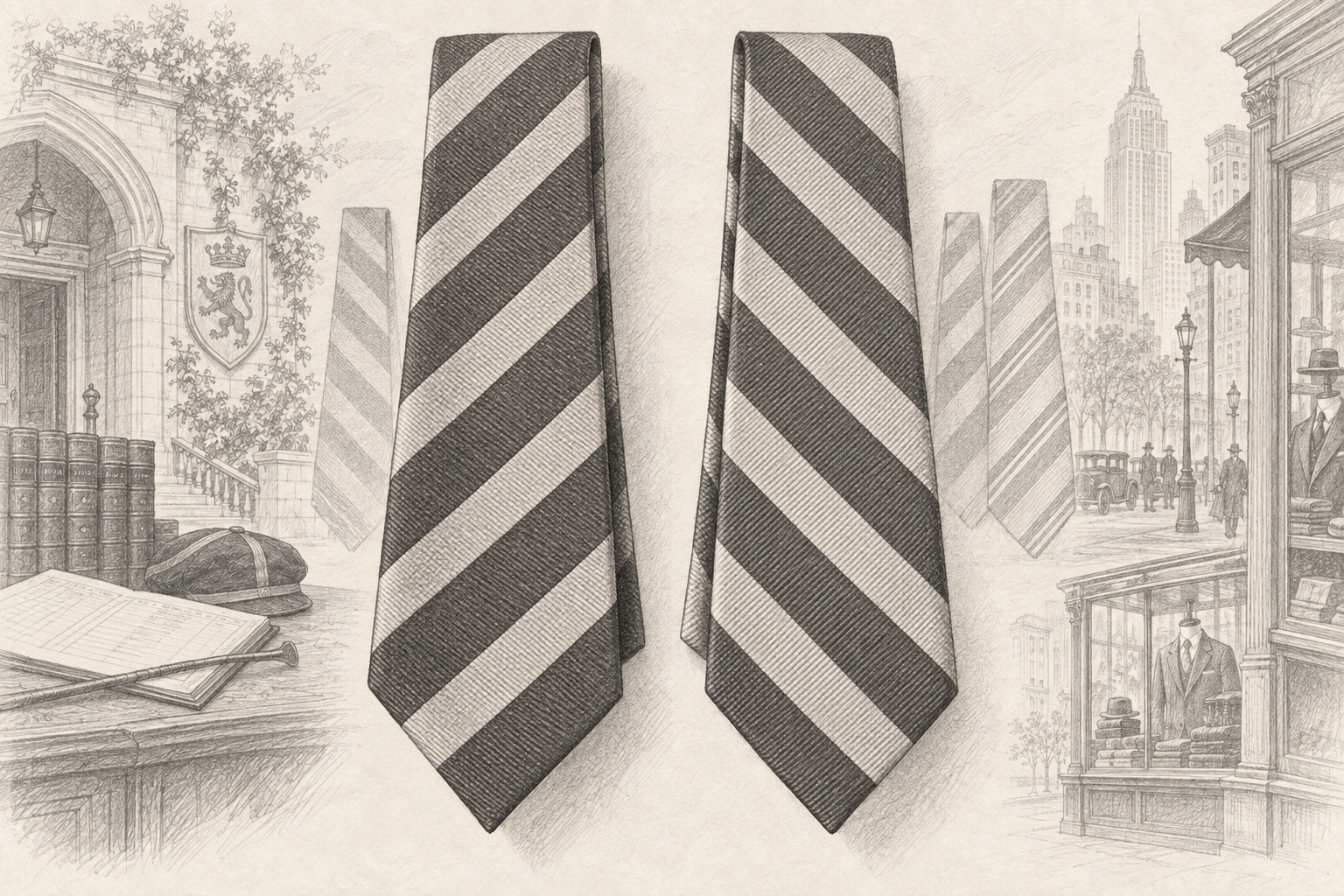
Diagonal tie stripes carry more than color and shape. In Britain they could identify a regiment, school, or club. Brooks Brothers says it reversed the direction of the familiar British stripe when introducing its classic repp tie to a wider American audience. This history does not establish one rule for every product from every period.
In Britain, a tie could signal membership
The word regimental comes from regiment. Brooks Brothers Japan explains that British soldiers wore striped ties as signs of their regiments. Colors and stripe combinations could therefore express a relationship between wearer and organization. Source: Brooks Brothers Japan, Repp Tie
The connection remains visible today. The Honourable Artillery Company sells regimental ties to members, and limits eligibility for its Honours Tie to those with qualifying sporting achievements. Source: HAC, Ties
Brooks Brothers Monaco also explains that British regimental-tie style spread to social clubs and boarding schools. It belonged to military, school, and social cultures rather than decoration alone. Source: Brooks Brothers Monaco
Reversing the stripe and separating it from affiliation
Brooks Brothers timelines date the introduction of the reverse-stripe repp tie to 1902. The Korean official timeline labels the episode “Democratizing the Repp Tie” and describes taking the style beyond its earlier meaning. The Monaco site says the stripe was reversed to separate its form from the affiliation it traditionally represented. Source: Brooks Brothers Korea
On that account, reversal allowed customers to enjoy the striped design without claiming membership in a particular British group. These are retrospective brand histories; they are not direct evidence from a surviving 1902 design brief.
Widening choice, rather than declaring a revolt against class
The brand's word “democratizing” is best read here as widening the group of people who could wear and enjoy the pattern. The checked sources do not prove that Brooks Brothers reversed the stripe specifically to reject the British class system. Regiment, school, club membership, and social class should not be treated as identical.
Repp is the fabric; stripe is the pattern
Brooks Brothers Japan describes a repp tie as using a lustrous ribbed weave. Repp refers to the fabric, while stripe refers to the pattern. Not every diagonal-striped tie belongs to a regiment, and not every repp tie represents membership.
Do not turn reverse-stripe history into a rule for every product
The classic stripe shown by Brooks Brothers Japan descends to the wearer's right when viewed from the front. That history does not prove that every Brooks Brothers striped tie must run in that direction.
Brooks Brothers has also sold Irish poplin ties. A 2024 company announcement described a silk-and-wool fabric recreated by Stephen Walters in Britain and ties finished by MANE in the United States. Fabric name, fabric origin, and country of final manufacture therefore need to be checked separately. Source: Brooks Brothers Japan 2024 archive collection announcement
Stripe direction alone should not be used to determine brand or authenticity. Examine the visible face of the tie together with its label.
Choosing the pattern as your own
When selecting a vintage tie, color and width are only part of the story. A genuine regimental or school tie may carry a specific affiliation worth researching. For the Brooks Brothers reverse stripe, the brand's account presents a British tradition adapted so more people could wear it as personal style.