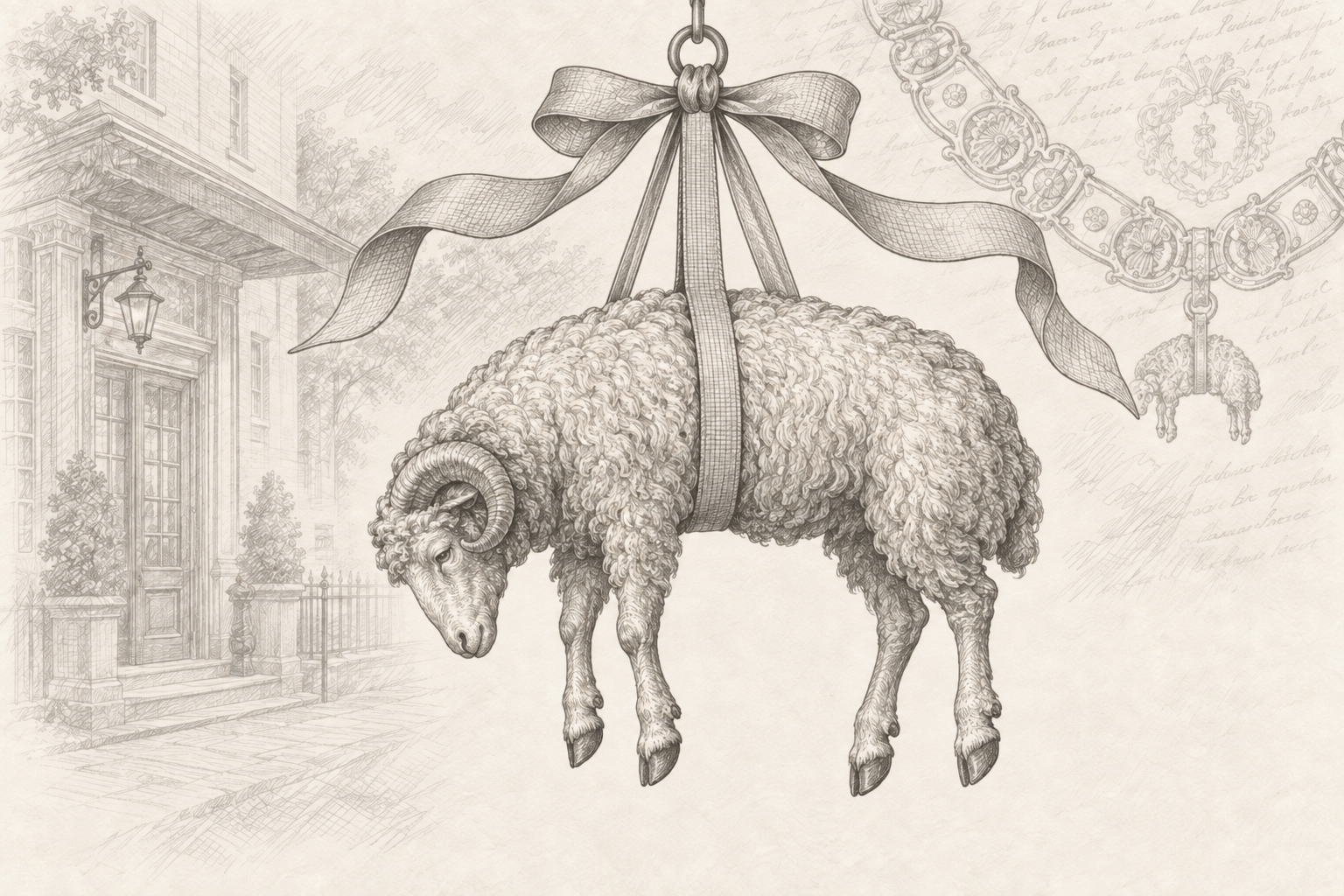
Look closely at the Brooks Brothers emblem and you will see a sheep suspended from a ribbon. Familiar from chest embroidery and labels, this small device carries a history that crosses Greek myth, European chivalric orders, and the signs of wool merchants.
The Golden Fleece sought by a hero
In Greek mythology, the Golden Fleece is the treasure Jason and the Argonauts set out to obtain. The Metropolitan Museum of Art explains that Pelias promised to surrender the throne if Jason returned with it. The fleece was therefore both a precious object and the goal of a journey to recover kingship. Source: The Metropolitan Museum of Art
In 1430, the fleece became the badge of an order
Philip the Good, Duke of Burgundy, founded the Order of the Golden Fleece in 1430 on the occasion of his marriage to Isabella of Portugal. The Fondation Napoléon notes that the order also gathered powerful nobles around the duke and displayed dynastic authority. The mythical treasure had become a wearable sign of social and political affiliation. Source: Fondation Napoléon
The suspended form also appears as a pendant
Collars of the order carry a Golden Fleece hanging below the chain. A late nineteenth-century miniature badge in the British Museum shows an inscription, flint and flames, with the fleece suspended beneath them; its reverse depicts Jason and the fleece. Source: British Museum
This does not mean the order's badge and the Brooks Brothers logo are identical. The shared element is the historic Golden Fleece motif, rather than the entire decoration of flint and flames.
For wool merchants, it identified their trade
Brooks Brothers' European history explains that the Golden Fleece became a symbol of fine wool and was later used by European wool merchants to tell passers-by what they sold. In this setting the device worked as a practical shop sign connecting wool, clothing, and commerce. Source: Brooks Brothers Europe
Myth, chivalric order, and shop sign belong to different contexts. The motif accumulated different meanings as it moved among them.
Above the New York store door
Brooks Brothers Japan states that the company placed the Golden Fleece above its store door in 1850 and has treated it as a symbol of tradition, quality, and service. The European history says the Brooks family adopted it to connect the store with European clothing traditions. Source: Brooks Brothers Japan
Official regional sources differ by one year: the Japanese account gives 1850, while the European timeline gives 1851. This article follows the Japanese account when describing the sign above the door.
A small emblem with a long clothing history
The Golden Fleece has served as a mythical treasure, a chivalric badge, a merchant's sign, and finally a symbol of Brooks Brothers. On a modern garment it is not a statement that the item itself is made of wool; material and date must still be checked on the individual labels.
The next time you see the suspended sheep on a chest or label, it can be read as an entrance into the history behind the clothes.