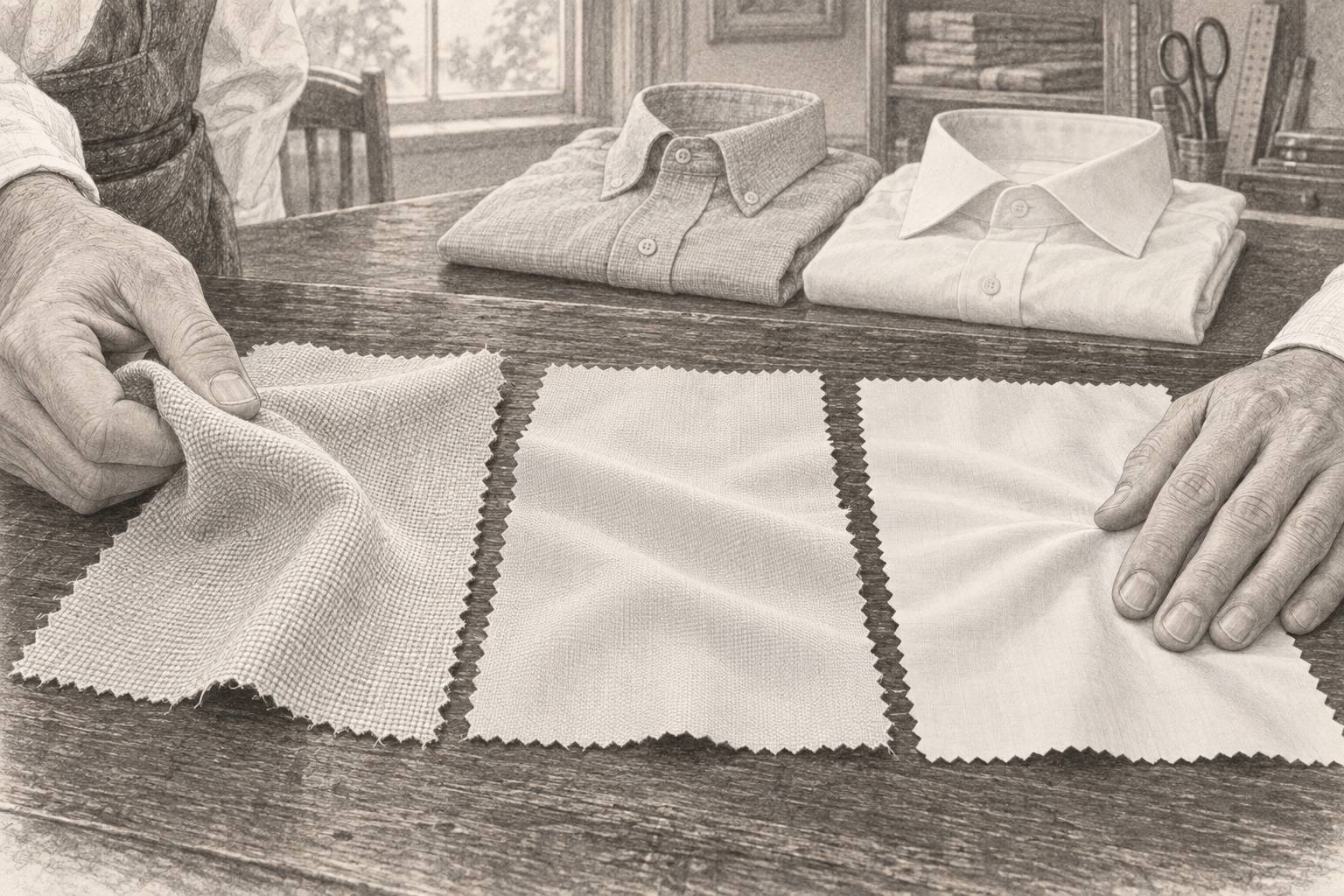
Even among white Brooks Brothers shirts, one may show a grainy weave while another looks flat and clean. Fabric is one difference that color and size alone do not reveal.
Oxford, Pinpoint Oxford and Broadcloth refer to weaves or kinds of cloth, not grades of cotton. A useful starting point is: Oxford for visible texture, Pinpoint for a finer surface, and Broadcloth for smoothness. Then consider where you will wear it and the actual thickness and condition of that shirt.
The fabric illustration below is an aid to imagining these surfaces, not a photograph of actual merchandise. Thickness and sheen vary from shirt to shirt.
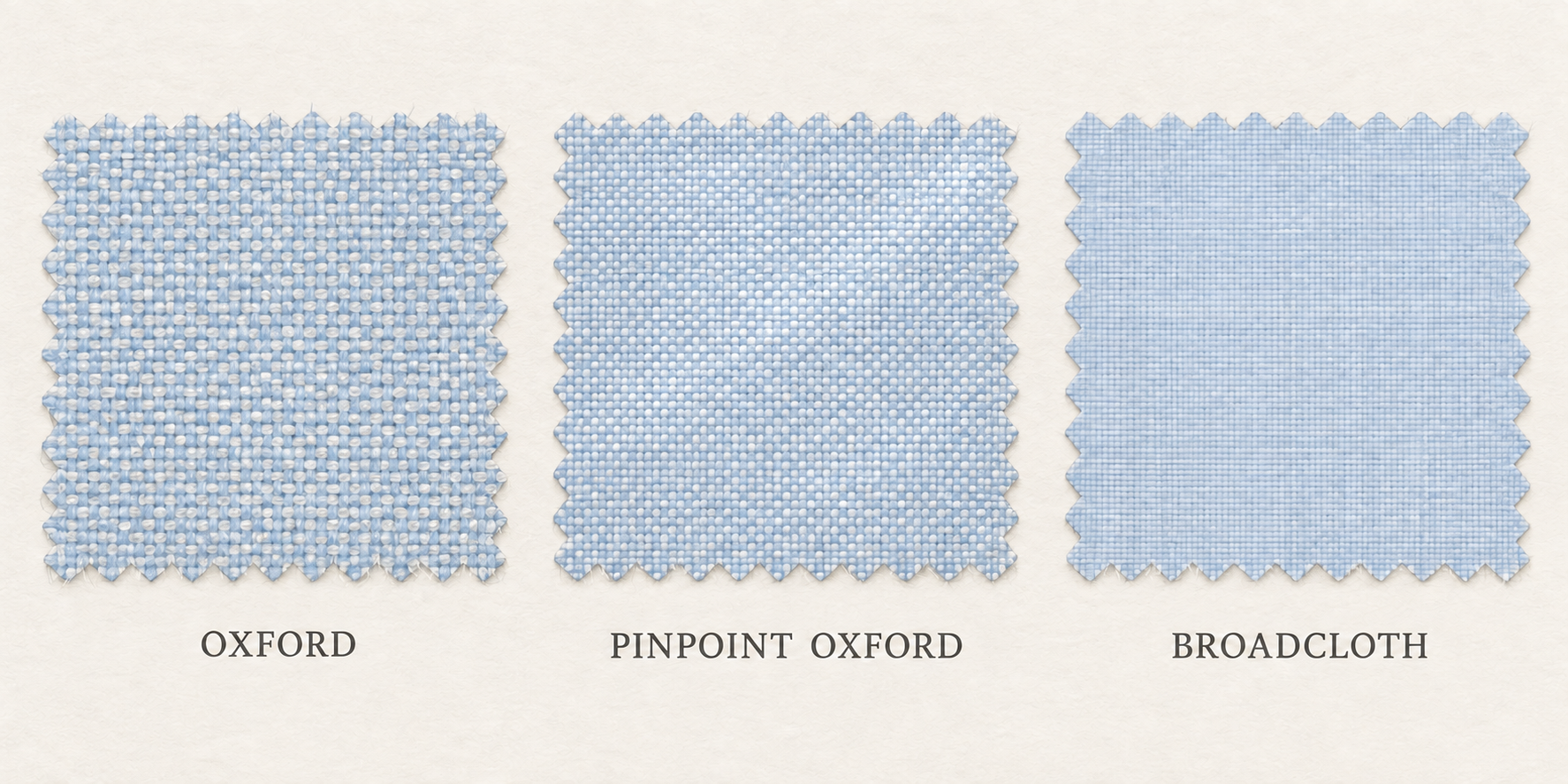
Oxford: a cloth with visible texture
Oxford is characterized by a basket weave. Its surface has a visible, grain-like texture and generally feels more dimensional than broadcloth. The Brooks Brothers Thailand fabric guide likewise describes its basket-weave texture and usefulness for casual shirts. Brooks Brothers Thailand fabric guide
That texture can suit a Polo Collar Shirt worn on its own at weekends or under a blazer. Yet Oxford is not always heavy: yarn size, density and finishing vary. Oxford names the cloth; Polo Collar names the collar shape. Not every button-down shirt is Oxford.
Pinpoint: a finer Oxford
Pinpoint Oxford uses the same general family of weave with finer yarns and a tighter construction. It looks finer and cleaner than ordinary Oxford. Proper Cloth explains the distinction mainly through yarn size and density. Proper Cloth on Pinpoint Oxford
Brooks Brothers Japan has also described examples as finer, smoother and dressier than regular Oxford. Brooks Brothers Japan example Pinpoint can sit between Oxford and Broadcloth as a practical guide to appearance. That does not mean it mixes the two fabrics or represents a higher grade of Oxford.
Broadcloth: a flat, smooth surface
Broadcloth is a plain weave in which warp and weft cross alternately. Its texture is usually less conspicuous, producing a clean surface. Proper Cloth describes it as tending to be relatively thin and light, with little visible texture. Proper Cloth fabric guide
Brooks Brothers Japan has offered broadcloth dress shirts described as flat and dressy, suitable when you want a clean surface with a suit or jacket. Brooks Brothers Japan example White or low-density cloth may show what is worn underneath, but not every Broadcloth is transparent, nor are Oxford and Pinpoint guaranteed opaque.
Are Broadcloth and Poplin the same?
Product descriptions sometimes use Broadcloth and Poplin almost interchangeably. Brooks Brothers Thailand introduces Poplin as a cloth also called Broadcloth. Brooks Brothers Thailand on Poplin Proper Cloth notes a technical difference involving warp and weft yarn sizes, but does not separate the terms in its own product descriptions. It is safer to treat them as closely related plain weaves and check the wording for the individual product. Proper Cloth on terminology
Royal Oxford, despite its name, has a different surface from ordinary Oxford and Pinpoint. Do not read it simply as another thickness of the same cloth.
Work, weekends and seasons: how to choose
Choose Oxford for visible texture, Pinpoint for a finer version of that expression, and Broadcloth for a flat, clean surface. Also consider color, pattern and collar. Plain white Broadcloth can feel quite formal and harder to use casually; Oxford is often easier for relaxed wear. Conversely, plain white Broadcloth is a good formal choice with a suit and tie, subject to the dress code and collar details.
Broadcloth may be a candidate when seeking something light, but the name alone does not determine coolness. Actual thickness, density, sleeve length, ease and layering all matter. Compare it with a shirt you already find comfortable.
Different information from Cotton, Supima and Non-Iron
Cotton and Supima describe fiber or cotton material. Oxford and Broadcloth describe cloth. Non-Iron describes a wrinkle-resistant treatment. “Supima Cotton, Pinpoint Oxford, Non-Iron” can therefore describe raw material, fabric type and treatment on one shirt without contradiction.
No single word determines hand feel or ease of care. Processing, composition, laundering, wear and storage all change how a pre-owned shirt feels today.
For pre-owned shirts, read the fabric name with close-up photos
If a fabric name is provided, read it first, then use close-ups for the weave and full views for the overall impression. Photographs cannot fully convey hand or thickness, so ask before buying if needed.
A 100% cotton label does not establish Oxford or Broadcloth. Similar-looking fabrics exist, and there is no need to force a classification from a photograph alone. A soft or translucent appearance is not by itself proof of wear or good condition; distinguish the original character of the cloth from localized abrasion or thinning.
Even in the same white or blue, the weave changes the expression. Once the size is right, the surface of the fabric is another clue for bringing a Brooks Brothers shirt closer to the way you want to wear it.