You find an older Brooks Brothers “Slim Fit” shirt you like and buy another with the same name, only to discover a different shape. Changes in fit names help explain such mismatches.
We summarized these names on our Instagram. Here we compare period guidance with official information available today. Knowing how names connect is different from assuming that their measurements are identical. Our guide to fit names
Around 2015, descriptive terms gave way to proper names
A Put This On article dated April 6, 2015 preserves a Brooks Brothers guide from the period. It pairs Milano with Extra Slim, Regent with Slim, Madison with Regular, and Traditional with Relaxed. Put This On: the period fit-name guide
For that guide, Extra Slim corresponds to Milano, Slim to Regent, and Regular to Madison. Reading an old Slim tag as Milano, or Regular as Regent, can therefore suggest a fit one step away from the original position.
The writer describes the change as having happened shortly before publication, so April 6, 2015 is not treated as the exact changeover date. Nor does the guide prove that every product worldwide changed on one day or retained identical measurements.
The same name can occupy a different position in another period
The five-fit US guide viewed in September 2026 describes Soho as Extra Slim, Milano as Slim, Regent as Regular, Madison as Relaxed, and Traditional as Extra Relaxed. Compared with the 2015 image, Milano’s descriptor has shifted from Extra Slim to Slim. Brooks Brothers US: five-fit guide
The US site also provides a separate three-part dress-shirt guide: Slim Fit, Regular Fit, and Traditional Fit. Slim is described with a narrower chest and body and higher armholes; Regular with standard room in the chest, body and sleeves; and Traditional with more room through the body and sleeves. Brooks Brothers US: three-fit dress-shirt guide
Because different systems coexist on the official site, one page cannot establish that every product after a given year uses one naming scheme. Check the description and measurements for the particular shirt. Name history is a map for vintage shopping, not proof of manufacture date or size.
The body can differ even when the collar size is the same
With dress shirts, collar and sleeve length are chosen first, then the body shape through the fit. A shirt that fits the neck may still lack room at the stomach or back. Increasing collar size merely to gain body room can leave the collar too loose.
In the five-fit guide, Soho is the narrowest category and has back darts. Fit names indicate a general order of slimness, but the chest and waist do not change in the same proportion.
Chest and waist differences reveal the shape
In the guide’s metric comparison, Milano is about 7 cm smaller at the chest and 4 cm smaller at the waist than Regent. Madison is about 6 cm larger at the chest and 8 cm larger at the waist. Traditional is about 13 cm larger at both points, while Soho is about 13 cm smaller at both. These are official comparison figures, not measurements of surviving shirts from every period.
Madison’s waist increases more than its chest. The shirt is not simply enlarged uniformly; the distribution of ease changes. This can help when the chest fits but the buttons pull at the stomach.
These chest and waist circumferences are different from the flat pit-to-pit width commonly used by secondhand shops. “6 cm larger at the chest” does not mean “6 cm wider pit to pit.”
From Regent to Regular: an example of more than a name change
Brooks Brothers Japan states that dress shirt 330000373 in Regular Fit has different measurements from the former Regent Fit. This example alone shows that “Regular” cannot automatically be treated as dimensionally identical to an older Regent. Brooks Brothers Japan: item 330000373
For size 15 1/2, the listed garment measurements are a 41.0 cm collar, 114.3 cm chest, 106.0 cm waist, 47.5 cm shoulders, and 76.2 cm length. The nominal 15 1/2 inches converts to about 39.4 cm, which does not equal the listed 41.0 cm garment collar. The size name, garment measurement, and body measurement must be read separately.
These are new-garment figures for one product. Comparing them with an older Regent in hand requires measuring that individual shirt.
Read the name and measurements, not just the tag color
The US guide uses red-label examples for both Madison and Traditional. Color alone therefore cannot distinguish them. Read the full tag and identify the product category as well.
Measure one shirt that already works for you
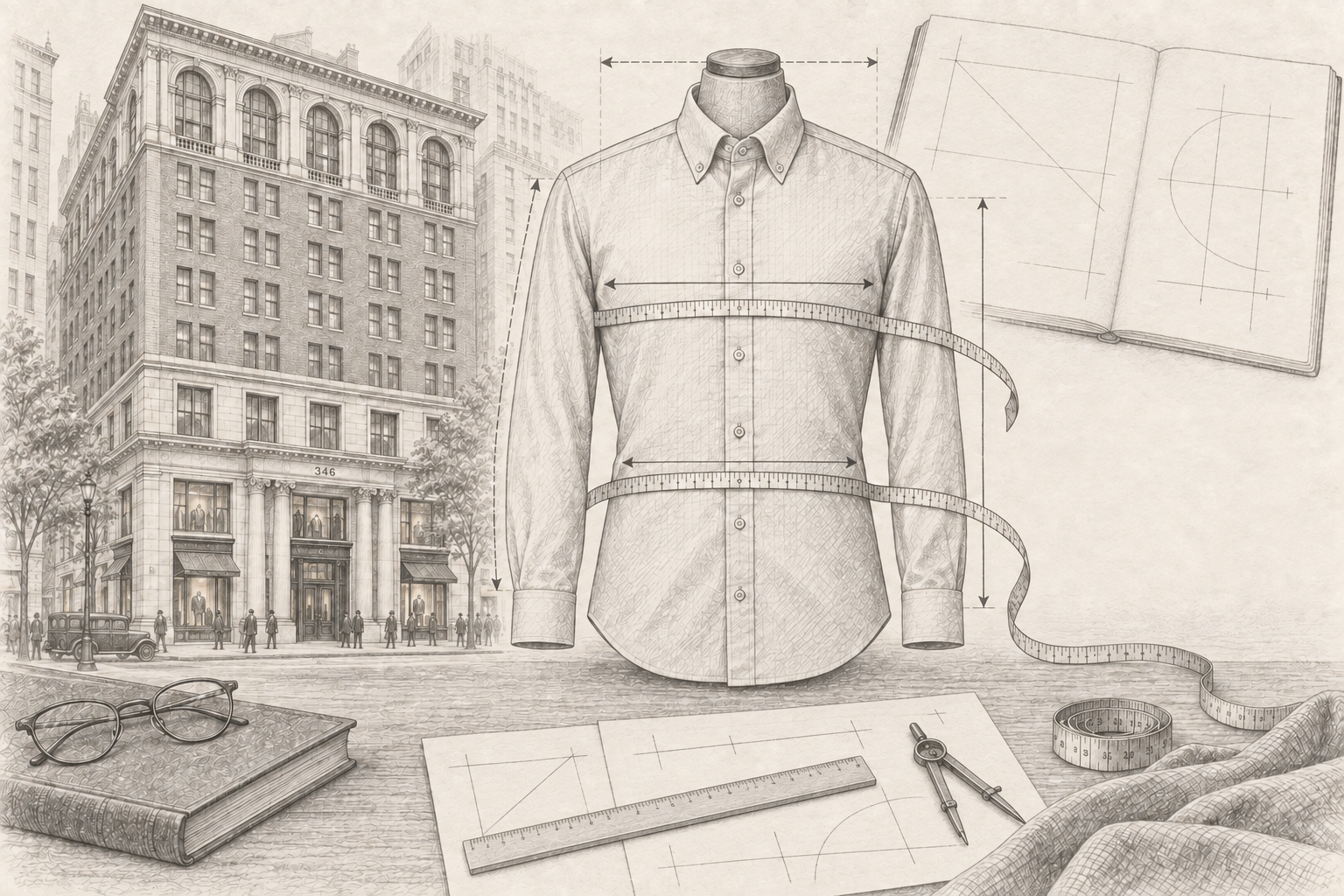
Lay a comfortable shirt flat and record the chest width, width near the waist, shoulder width, and length. Also note whether the sleeve figure is measured from the shoulder or as center-back sleeve length. Measurements taken the same way can be compared across different fit names.
If you wear a tie, prioritize the collar. If you sit for long periods, consider room through the body. If you wear the shirt untucked, consider the length. Your intended use clarifies the ease you need.
A fit name is the entrance to finding a shape. Reading the measurements beyond it connects Brooks Brothers’ many choices to your own comfort.